Panorama of Emergency Medicine

PoEM is an international peer-reviewed (double-blind) independent open access journal dedicated to advancing knowledge and practice in emergency medicine.

ISSN : 3006-0966

Skip to main navigation menu Skip to main content Skip to site footer

Disaster & Crisis Management

2 Items

All Items

  • Emergency Staff Perceptions of Mass Casualty Management Effectiveness in Lebanese Hospitals: A Cross-Sectional Study

    Introduction

    Mass Casualty Incidents (MCIs) present significant challenges to hospitals, often overwhelming available resources and requiring rapid, coordinated responses. Effective casualty management plans are essential to ensure optimal patient care during such crises. Key components include staff training, interdepartmental communication, resource allocation, psychological support, and post-disaster evaluation.

    Objective
    This study aimed to evaluate the perceived effectiveness of disaster management plans in Lebanese hospitals from the perspective of emergency staff responsible for implementing Mass Casualty Management (MCM) plans.

    Materials and Methods
    A cross-sectional quantitative study was conducted with 71 emergency staff members, including chiefs and personnel directly involved in MCM, from 12 public and private hospitals across Lebanon. Data were collected via a structured questionnaire covering demographics, overall plan effectiveness, specific plan components (triage, communication, coordination, resource allocation), and open-ended suggestions. 

    Results
    Significant positive correlations were observed between staff training and perceived plan effectiveness (r = 0.528, p < 0.01), perceived triage efficiency and the staff’s perception of reduced mortality and morbidity (r = 0.505, p < 0.01), resource allocation and perceived plan effectiveness (r = 0.572, p < 0.01), communication and team coordination (r = 0.481, p < 0.01), and psychological support and staff satisfaction (r = 0.541, p < 0.01).

    Conclusion
    Emergency staff perceive continuous training, effective communication, optimized resource allocation, and psychological support as critical to improving the effectiveness of MCM plans. Hospitals should adopt an integrated approach that combines these elements with systematic post-disaster evaluation to strengthen preparedness, staff resilience, and patient care during mass casualty incidents.

    Introduction
    Context
    Lebanon has faced repeated crises in recent years, including the Beirut port explosion of 2020, ongoing political instability, and strained healthcare resources, that have exposed critical vulnerabilities in hospital preparedness for Mass Casualty Incidents (MCIs). MCIs are large-scale emergencies that generate a sudden influx of patients with diverse and severe injuries, often exceeding the capacity of local healthcare
    systems [1]. These events place hospitals under extreme pressure, especially in resource-limited settings, and highlight the need for structured preparedness and response strategies [2]. Without adequate planning, the continuous arrival of casualties can quickly destabilize hospital systems, increasing morbidity and
    mortality [3].
    Mass Casualty Management (MCM) provides an essential framework for mitigating these challenges. It encompasses measures to optimize resource allocation, organize patient care, and coordinate inter-institutional efforts to ensure equitable distribution of patients and continuity of hospital services [4].Within this framework, the crisis management cycle outlines key phases: immediate response, relief, rehabilitation, prevention, mitigation, and preparedness. Each phase requires coordinated actions among hospitals, government agencies, and community stakeholders to strengthen resilience and reduce disaster impact [5].
    Effective crisis response depends on three fundamental principles: triage, communication, and adaptability. Triage enables prioritization of care, maximizes survival outcomes, and ensures efficient use of limited resources [6]. Clear communication among hospitals, emergency services, public authorities, and international organizations reduces delays and errors, while centralized information systems support timely decision-making [7]. Flexibility and adaptability are equally critical, as crises often create unpredictable demands that require rapid redistribution of resources and decentralized decision-making at the frontline level [8].
    Hospital preparedness is further enhanced through MCM training programs, which strengthen the capacity of health systems to respond effectively to crises. Evidence demonstrates that such training improves staff performance in three key areas. First, it enables faster and more coordinated responses by standardizing protocols, thus reducing delays in patient care [8]. Second, it improves patient flow management through more accurate triage and better allocation of medical units, preventing service blocks [9]. Third, it enhances communication across stakeholders, ensuring real-time coordination and optimal use of available resources [1]. By improving efficiency, patient management, and interprofessional collaboration, MCM training may contribute to a perceived reduction of preventable mortality and morbidity during disaster events [10]. However, despite growing international literature on hospital disaster preparedness, there is limited evidence from Lebanon examining how frontline emergency staff perceive the effectiveness of mass casualty management plans and their key operational components in real-world crisis settings.

    Objective
    This study aimed to assess emergency staff perceptions of the effectiveness of mass casualty management plans in Lebanese hospitals and to examine perceived associations between key plan components and perceived management effectiveness.

    Materials and methods
    This quantitative cross-sectional study was conducted to evaluate the effectiveness of disaster management plans in Lebanese hospitals. Data were gathered from a purposive sample of 71 nursing leadership and supervisory staff members directly involved in the operational implementation of Mass Casualty Management (MCM) protocols. Participants were recruited using a non-probability convenience sampling approach. In each participating hospital, a local contact person facilitated questionnaire distribution to eligible emergency staff directly involved in mass casualty management. Because participation depended on availability and willingness to respond, the sample may not be fully representative of all emergency personnel within each institution. While this method ensured high-level perspectives on departmental coordination, we acknowledge that reliance on availability and the specific targeting of management may introduce selection bias by excluding broader frontline staff. Consequently, these findings reflect the insights of nursing leadership and should be interpreted with caution regarding their generalizability to the wider Lebanese healthcare workforce.
    Data collection was performed using a structured questionnaire divided into four sections:
    - Section A: Demographic information
    collected participants’ personal and professional characteristics, including gender, age, years of experience, and hospital type.
    - Section B: Evaluation of the disaster management plan
    measured participants’ perceptions of their hospital’s disaster management plan using a Likert scale ranging from “strongly disagree” to “strongly agree.”
    - Section C: Specific components of the plan
    assessed critical elements of the disaster management plan, including triage systems, communication protocols, and collaboration with external agencies.
    - Section D: Results and recommendations
    comprised open-ended questions allowing participants to suggest improvements and recommend training initiatives.

    The data collection process included the following steps:
    1. Authorization:
    Obtaining approval from relevant ethics committees and hospital authorities.
    2. Coordination:
    Designating a contact person at each hospital to facilitate questionnaire distribution and collection.
    3. Distribution:
    Providing questionnaires in either paper or electronic format, according to hospital preference.
    4. Collection:
    Gathering completed questionnaires over a one-month period, with regular reminders to maximize response rates.
    5. Validation:
    Reviewing completed questionnaires to ensure completeness and alignment with study objectives.
    To ensure validity, a pilot test was conducted with 10 nurses prior to full-scale distribution. Reliability was assessed using Cronbach’s alpha, demonstrating excellent internal consistency of the survey items (⍺= 0.933).

    Data Analysis
    Collected data were entered into SPSS version 26 (IBM Corp., Armonk, NY, USA) for statistical analysis. Descriptive statistics, including frequencies, percentages, means, and standard deviations, were used to summarize participants’ demographic characteristics and responses regarding disaster management plans.
    Inferential statistics were applied to assess relationships between variables. Pearson correlation coefficients were calculated to examine the association between staff training, resource allocation, communication, psychological support, and the perceived effectiveness of hospital disaster management plans. Significance was set at p < 0.05 for all analyses.
    Open-ended responses from Section D of the questionnaire were analyzed qualitatively using thematic content analysis. Responses were coded to identify recurring themes and recommendations for improving disaster management plans and training programs.
    The combination of quantitative and qualitative analyses allowed for a comprehensive evaluation of hospital disaster management strategies, providing both numerical associations and practical insights from frontline staff.

    Results
    Participant Demographics
    The study included 71 healthcare staff members from 12 public and private hospitals across Lebanon. Participants’ demographic characteristics are summarized in Table 1. The sample included both genders, with a slight predominance of females (55%). Age distribution ranged from 24 to 58 years, with a mean age of 36.4 ± 7.8 years. The majority of participants had between 5 and 15 years of professional experience (61%), while 20% had less than 5 years and 19% had more than 15 years. Participants were drawn from various hospital types, including 8 public hospitals (45%) and 4 private hospitals (55%). This diversity ensured a representative sample across hospital settings.

    Descriptive Analysis
    Table 2 presents descriptive statistics on participants’ perceptions of the effectiveness of the disaster management plan. Overall, the disaster management plan received a mean score of 3.75 out of 5, indicating a generally positive perception among hospital staff. Pre-crisis training in disaster management protocols was rated 3.62, suggesting moderate preparedness but highlighting area for improvement.
    Coordination between medical teams (mean = 3.68 ± 0.858) and resource allocation (mean = 3.70 ± 0.901) were perceived as relatively effective. In contrast, the consideration of staff psychological needs received a lower mean score (3.18 ± 1.004), identifying a key area requiring further attention. Integration of external agencies (mean = 3.65 ± 0.987) and interdepartmental communication (mean = 3.59 ± 0.748) were rated moderately positive. The perceived impact of the plan on reducing mortality and morbidity was favorable (mean = 3.66 ± 0.877). These findings highlight the need for targeted improvements in pre-crisis training and psychological support (Table 2).

    Inferential Analysis
    Training and perceived effectiveness
    Pearson correlation analysis revealed a significant positive relationship between disaster management training and the perceived effectiveness of the plan (r = 0.528, p < 0.01; Table 3). This finding suggests that greater perceived adequacy of training is associated with higher perceived effectiveness of the disaster management plan.

    Triage efficiency and perceived reduction in mortality and morbidity
    A significant correlation was observed between triage efficiency and perceived reduction in mortality rates (r = 0.505, p < 0.01; Table 4). Structured triage systems and training could lead to improved patient survival during mass casualty events.
    Resource allocation and plan effectiveness
    Efficient allocation of hospital resources was strongly correlated with the perceived effectiveness of the disaster management plan (r = 0.572, p < 0.01; Table 5).
    Hospitals with better management of staff, equipment, and supplies demonstrated increased capacity to handle mass influxes of patients.
    Communication and coordination
    Clear communication between medical teams was significantly associated with improved coordination during crisis management (r = 0.481, p < 0.01; Table 6). This underscores the importance of standardized communication protocols and technologies, such as briefing meetings and instant messaging systems, to enhance hospital response.
    Psychological care and staff satisfaction
    Psychological support for staff was positively correlated with overall staff satisfaction regarding the disaster management plan (r = 0.541, p < 0.01; Table 7). These findings highlight the value of post-crisis consultations, debriefing sessions, and stress management training in promoting staff well-being and sustaining effective disaster response.
    Thematic Analysis of Open-Ended Responses
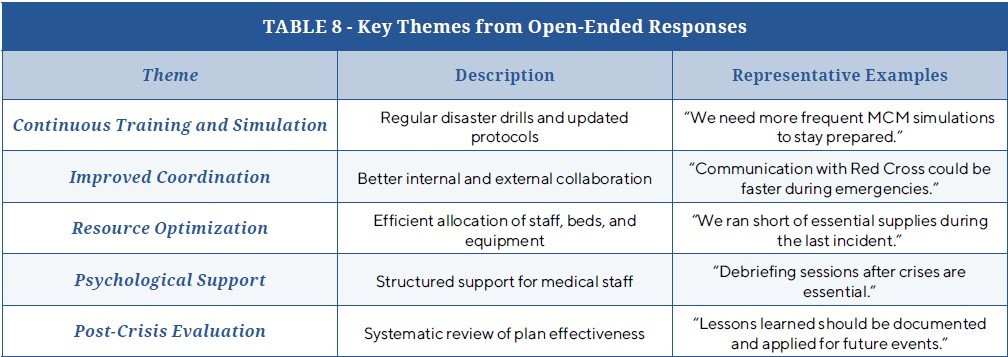
    Analysis of open-ended responses identified five key themes highlighting staff concerns and recommendations (Table 8):
    1. Continuous training and simulation:
    Staff emphasized the need for regular disaster drills and updated training programs to maintain preparedness.
    2. Improved coordination:
    Enhancing coordination within departments and with external partners, such as the Red Cross and Civil Defense, was recommended.
    3. Resource optimization:
    Respondents highlighted the importance of effective allocation and management of human and material resources during crises.
    4. Psychological support:
    Providing structured psychological care for medical staff was consistently identified as a critical gap.
    5. Post-Crisis evaluation:
    Establishing systematic post-crisis assessments was suggested to refine disaster management plans and incorporate lessons learned.
    Overall, the combination of quantitative and qualitative findings indicates that Lebanese hospitals generally implement effective disaster management plans but require targeted improvements in staff training, psychological support, resource management, and post-crisis evaluation.

    Discussion
    The results of this study provide clear insights into the effectiveness of disaster management plans in Lebanese hospitals and the factors influencing their success. By combining quantitative and qualitative analyses, this research demonstrates that staff training, interdepartmental coordination, resource allocation, and psychological support are all critical components of effective Mass Casualty Management (MCM).
    The observed positive correlation between staff training and perceived plan effectiveness (r = 0.528, p < 0.01) confirms that well-trained personnel significantly enhance the hospital’s emergency response capabilities. These findings align with Yao & Kuago (2022), who reported that regular simulation exercises and practical training improve caregivers’ preparedness, reduce errors, and facilitate rapid, coordinated action in crises [11]. Similarly, Bodina et al. (2017) highlighted those hospitals investing in comprehensive theoretical and practical training experience better interdepartmental coordination and overall plan efficiency [12].
    Effective communication and coordination among hospital teams were significantly correlated (r = 0.481, p < 0.01), emphasizing that clear communication channels are essential to ensure smooth patient flow and minimize errors during emergencies. These results corroborate the work of Xue et al. (2020), who demonstrated that structured protocols and regular inter-agency meetings enhance operational efficiency [13]. Furthermore, Soltani-Sobh et al (2016) highlighted that communication training and pre-established collaboration agreements with external organizations, such as the Red Cross, improve response quality during disasters [7].
    Resource allocation emerged as a key determinant of plan effectiveness, with a strong positive correlation (r = 0.572, p < 0.01). Hospitals with better management of staff, medical supplies, beds, and equipment were more capable of handling patient surges. This aligns with Yao et al. (2022), who emphasized that efficient resource management, supported by inventory systems and digital monitoring technologies, improves emergency care outcomes and overall hospital preparedness [14].
    The study confirms that psychological care for hospital staff significantly impacts their satisfaction and performance during crises (r = 0.541, p < 0.01). These results support findings by Hussaini et al 2023, who advocate for structured post-crisis debriefings, stress management training, and continuous psychological support to prevent burnout and maintain quality care. Integrating psychological support into MCM plans not only improves staff well-being but also indirectly enhances patient care and institutional resilience [5].
    An important finding of this study is that psychological support for staff received the lowest mean score among all assessed components (3.18 ± 1.004). In the Lebanese context, this result may reflect the cumulative burden of repeated crises, including the Beirut port explosion, prolonged economic instability, workforce shortages, and sustained occupational stress. These contextual pressures may contribute to emotional exhaustion and burnout among healthcare professionals, thereby limiting the perceived adequacy of institutional psychological support mechanisms.
    This finding suggests that psychological preparedness should be integrated more explicitly into hospital disaster plans through debriefing protocols, peer-support systems, referral pathways, and post-incident mental health follow-up.
    Responses to open-ended questions highlighted the importance of systematic post-crisis evaluation. Regular assessment of disaster management plans, as recommended by Tegegne et al. (2023), allows hospitals to identify weaknesses, implement corrective measures, and improve overall preparedness [15]. This iterative process, combined with nursing leadership/supervisors’ feedback, ensures continuous improvement, better resource allocation, and enhanced team coordination for future incidents.
    Overall, this study demonstrates that effective disaster management in hospitals is multifactorial. Staff training, communication, resource management, psychological support, and post-crisis evaluation are interdependent components that together enhance hospital preparedness, improve patient outcomes, and increase institutional resilience during mass casualty incidents.

    Strengths and limitations
    Strengths
    - The mixed-methods approach allowed for a comprehensive evaluation of disaster management plans by combining quantitative and qualitative analyses.
    - The quantitative instrument demonstrated high reliability, with an excellent internal consistency (Cronbach’s alpha = 0.933).
    - The research successfully identified and confirmed critical pillars of effective Mass Casualty Management (MCM), specifically staff training, communication, resource allocation, and psychological support, providing a robust framework for institutional assessment.

    Limitations
    Despite these strengths, several limitations must be considered:
    - The study utilized a non-probability convenience sampling approach with a relatively small sample size (N=71), which may limit the generalizability of the findings to all hospitals in Lebanon. Furthermore, by targeting nursing leadership and supervisors as key informants, the study captures high-level perspectives on departmental oversight but may introduce selection bias. Consequently, the findings primarily reflect the insights of nursing management and may not fully capture the frontline experiences of bedside emergency staff.
    - The reliance on self-reported data may introduce participant perception bias. Additionally, the possibility of common method bias exists, as both predictor and outcome variables were collected from the same respondents simultaneously. This suggests that some observed associations may partly reflect general response tendencies rather than distinct underlying constructs.
    - The cross-sectional design restricts the ability to evaluate the long-term evolution of hospital practices over time. More over, the focus on specific institutional contexts means the results may not be directly comparable to facilities with different infrastructures or policies.
    - While the study distinguished between leadership and staff involved in MCM, detailed professional sub-categories were not systematically captured. Incorporating objective metrics, such as response times or mortality rates, in future research would provide a more granular assessment of MCM effectiveness.

    Ethical considerations
    Ethical approval was obtained from the Ethical Committee-Holy Family University, approval number [004/2026]. Administrative authorization was also obtained from the participating hospitals.

    Conclusion
    This study highlights that, from the perspective of emergency staff, disaster preparedness in Lebanese hospitals depends on several interrelated dimensions, particularly training, communication, resource allocation, and psychological support. The findings should be interpreted as staff perceptions rather than objective measures of clinical effectiveness. Nevertheless, they identify priority areas for strengthening hospital disaster readiness. Practical implications include regular simulation-based training, clearer interdepartmental communication pathways, formal staff support mechanisms after crisis events, and structured post-incident audits to guide continuous quality improvement. Future studies should combine staff perceptions with objective institutional indicators and clinical outcomes to provide a more comprehensive assessment of mass casualty management effectiveness.

    Author contributions
    Eliana GHAZAL: Conceived the study, wrote the introduction, and participated in the discussion.
    Dunya NOHRA: Developed the methodology and contributed to data interpretation.
    Maha NEHME: Conducted data analysis and participated in the discussion and conclusion.
    Hilda CHELALA: Provided critical feedback on the manuscript.
    All authors validated the final version of record.
    Declarations
    Conflicts Of Interests
    The Author declares that there is no conflict of interest.
    Funding
    This research received no specific grant from any funding agency in the public, commercial, or not-for-profit sectors.
    Registration
    No registration applicable.
    Data availability statement
    The data that support the findings of this study are available from the corresponding author upon reasonable request.
    Ethical approval
    Ethical approval for this study was not required.

    References

    1.    Alpert EA, Kohn MD. EMS Mass Casualty Response. In: StatPearls [Internet]. Treasure Island (FL): StatPearls Publishing; 2025. Available from: http://www.ncbi.nlm.nih.gov/books/NBK536972/
    2.    Staribacher D, Rauner MS, Niessner H. Hospital Resource Planning for Mass Casualty Incidents: Limitations for Coping with Multiple Injured Patients. Healthcare. 2023;11(20):2713. https://doi.org/10.3390/healthcare11202713
    3.    Aqtam I, Shouli M, Al-qoroum S, Shouli K, Ayed A. Evaluating Disaster Management Preparedness among Healthcare Professionals During Pandemics: Palestinian Context. Sage Open Nurs. 2024 Sep 19;10:23779608241283698. https://doi.org/10.1177/23779608241283698
    4.    Tong J. Mass casualty management. Int Anesthesiol Clin. 2021 Feb 9;Publish Ahead of Print. https://doi.org/10.1097/AIA.0000000000000315
    5.    Husaini BA, Sugiarto S, Rahmanand S, Oktari RS. Assessing hospital disaster preparedness: A scoping review of available tools. Narra J. 2023 Aug;3(2):e210. https://doi.org/10.52225/narra.v3i2.210
    6.    Saadatmand V, Ahmadi Marzaleh M, Abbasi HR, Peyravi MR, Shokrpour N. Emergency medical services preparedness in mass casualty incidents: A qualitative study. Health Sci Rep. 2023 Oct 19;6(10):e1629. https://doi.org/10.1002/hsr2.1629
    7.    Soltani-Sobh A, Heaslip K, Scarlatos P, Kaisar E. Reliability based pre-positioning of recovery centers for resilient transportation infrastructure. Int J Disaster Risk Reduct. 2016 Oct;19:324–33. https://doi.org/10.1016/j.ijdrr.2016.09.004
    8.    Bazyar J, Farrokhi M, Khankeh H. Triage Systems in Mass Casualty Incidents and Disasters: A Review Study with A Worldwide Approach. Open Access Maced J Med Sci. 2019 Feb 12;7(3):482–94. https://doi.org/10.3889/oamjms.2019.119
    9.    Hobbins J. Collective memories and professional ideals: Teachers’ experiences of a disaster. Int J Disaster Risk Reduct. 2021 Oct;64:102479. https://doi.org/10.1016/j.ijdrr.2021.102479
    10.    Holloway-Kew KL, Baker TR, Sajjad MA, Kotowicz MA, Livingston PM, Khasraw M, et al. The epidemiology of emergency presentations for falls from height across Western Victoria, Australia. Australas Emerg Care. 2020 Jun;23(2):119–25. https://doi.org/10.1016/j.auec.2019.09.002
    11.    Yao G. Flexible and adaptable : a strategy for future healthcare facility toward disaster and emergency [Internet] [Master’s thesis]. [Milan, Italy]: Politecnico Milano; 2022 [cited 2025 Sep 2]. Available from: https://www.politesi.polimi.it/handle/10589/188942
    12.    Bodina A, Pavan A, Castaldi S. Resource allocation criteria in a hospital. J Prev Med Hyg. 2017 Jun;58(2):E184–9. 
    13.    Xue CL, Shu YS, Hayter M, Lee A. Experiences of nurses involved in natural disaster relief: A meta-synthesis of qualitative literature. J Clin Nurs. 2020 Dec;29(23–24):4514–31. https://doi.org/10.1111/jocn.15476
    14.    Tegegne SG, Mengestu TK, Francisco K, Bollars C, Kapanga H, Galbert FT, et al. Process of developing Country Cooperation Strategy in Tanzania, as an effective tool for aligning WHO’s support to the member state in achieving health and health-related sustainable development goal. Pan Afr Med J. 2023;45(Suppl 1):2. https://doi.org/10.11604/pamj.supp.2023.45.1.39584
    15.    Higginbotham EJ, Church KC. Strategic planning as a tool for achieving alignment in academic health centers. Trans Am Clin Climatol Assoc. 2012;123:292–303

  • Seroprevalence of the General Lebanese Population to COVID-19 Between 2023 and 2024

    Background
    Understanding population immunity to SARS-CoV-2 is crucial for public health planning, especially Lebanon where unique healthcare
    challenges exist. This study aimed to assess the seroprevalence of SARS-CoV-2 antibodies and identify predictors of serostatus in a
    sample of the Lebanese population in 2023.

    Methods
    We conducted an observational study of 350 adult patients presenting to two emergency departments in Lebanon. Participants
    were tested using a ZEKMED COVID-19 IgG/IgM rapid test, a qualitative rapid SARS-CoV-2 anti-E antibody kit. A comprehensive
    statistical analysis including logistic regression, Bayesian modeling, and a Random Forest classifier was performed to identify predictors
    of IgG seropositivity.

    Results
    Our results showed high IgG seroprevalence of 95.1% (n=333), suggesting prevalent natural infection. While vaccination status and self-reported prior infection were not significant predictors of serostatus in standard analyses, both Bayesian and Random Forest models identified increased age as a potential predictor associated with a negative IgG antibody response (94% HDI: [-1.531, -0.000]; importance score: 0.61).

    Conclusion
    Our findings indicate high exposure to natural SARS-CoV-2 infection in this Lebanese cohort. However, the association of advanced age with a negative antibody response suggests that older populations may remain more vulnerable. This highlights the need for continued targeted public health surveillance and strategies despite high overall seroprevalence from past infections.

    Introduction

    Covid-19 infection is a recent pandemic, known to cause severe respiratory illness. Since the Coronavirus Infectious Disease 19 (COVID-19) pandemic hit, vaccination, infection control and immunity became a major interest for healthcare [1]. People were infected in groups, sometimes whole communities, which while overwhelming, contributed to population-level seroprevalence after resolution [2]. However, not everyone had the same COVID-19 presentation, as a large number of individuals had asymptomatic infection, detected by contact tracing or random antibody testing. Others acquired passive immunity through vaccination [3]. Historically speaking, as was the case with poliomyelitis and measles, a detectable immunity in up to 80 to 95% of the population is needed for effective herd immunity [3].
    In the case of COVID-19, the data shows a similar story. In the Unites States of America (USA), 60% adult vaccination rates did not provide enough population immunity to impede the virus spread [4, 5]. A similar trend was seen in Wales [6]. However, the Severe Acute Respiratory Syndrome Coronavirus-2 (SARS-CoV-2) is a ribonucleic acid (RNA) virus that mutates and creates new variants and strains [7]. In addition, the gained immunity wanes over time, which is why we sometimes over-estimate the immunity we have, ending up with a more vulnerable population with the coming variant waves, as in the case of New England in August
    2021 [8].
    Population level antibody responses for COVID-19 shows consistent international trends. However, they can be influenced by a variety of local factors unique to each region. For instance, the attitude of people in the Middle East towards lockdowns and vaccination would create unique conditions that influence seroprevalence in the region.
    In Lebanon, several studies emerged assessing the population immunity to COVID-19. A nationwide study published in January 2022 by Hoballah et al assessing over 2000 participants showed that despite all efforts to vaccinate the public, the population remained vulnerable to a new COVID-19 outbreak [9]. According to the World Health Organization (WHO), a total of 5,814,699 vaccine doses have been administered in Lebanon as of December 2022 [10]. Nevertheless, according to the Lebanese Ministry of Public Health (MoPH), we still have new infections and deaths related to COVID-19 as of May 2023 [11]. The vaccination rates are not likely to increase further, especially that a lot of the Lebanese people have concerns regarding vaccine safety and efficacy, rendering them unlikely to get vaccinated [12]. This is alarming in the setting of a country that suffers a suffering healthcare system due to massive challenges and a major economic collapse, making the country less likely to be able to deal adequately with a new wave [13].

    There is no new update regarding the Lebanese population preparedness and immune status regarding COVID-19. It is of importance to assess the population-level immunity in Lebanon against COVID-19, as it would provide updated insight on the magnitude of a possible new wave in the country, especially as social distancing and mask wearing measure have stopped. In addition, it would provide an idea of the how the Lebanese population reacts to new outbreaks.

    Methods

    Study Design and population

    Our study is an observational study conducted on a sample of patients presenting to the Emergency Departments (ED) at the Lebanese American University Medical Center – Rizk Hospital (LAUMC-RH) and Kesrwan Medical Center (KMC) between July 2023 and January2024. All adult patients above 18 years of age presenting to the ED were offered to perform a rapid fingerstick antibody test for COVID-19. This was done for any visit at any time in the ED, offered to all adult patients. People who cannot give an informed consent with waiver of documentation, and patients on chemotherapy and immunomodulators were excluded. Data collection included the number of COVID-19 vaccination doses and whether they had a prior COVID-19 infection in the past.

    Kits

    Detection of SARS-CoV-2 antibodies was performed using the ZEKMED COVID-19 IgG/IgM Rapid Test Cassette (ZENUM Sarl, Marly, Switzerland), which is a qualitative lateral flow immunoassay that was used with whole blood.14 It uses a colloidal gold-conjugated recombinant Coronavirus envelope antigen to detect IgG and IgM antibodies against the COVID-19 envelope protein (anti-E), with results interpreted at 15 minutes per the manufacturer’s instructions.15The kit’s performance has been independently validated, demonstrating a sensitivity of 97% and specificity approaching 100% in clinical trials [14].

    Sample size calculation

    Based on the standard for prevalence studies, a 95% confidence level (Z=1.96) and a 5% margin of error (d=0.05) were selected for reliability and precision. The expected prevalence (P) of IgG seropositivity was estimated at 85% (0.85). This estimation was informed by the high reported rates of prior SARS-CoV-2 infection and widespread vaccination coverage in the Lebanese population,16,17 while also accounting for antibody waning over time and detection capabilities of rapid IgG kits, which can miss very low titers. Using the formula for estimating a population proportion, n=(Z^2∙P(1-P))/d^2 , the initial calculation yielded approximately 196 participants. To increase the study power and account for non-response rates, incomplete data, or invalid test, a target sample size of 230 participants as a buffer was used. The study successfully recruited 350 participants, exceeding the calculated sample size, which increased the statistical power of the derived estimates of COVID-19 IgG immunity within this patient population.

    Statistics

    Descriptive statistics were used to summarize the demographic, clinical, and serological characteristics of the 350 participants. Bivariate analyses were performed to check associations with IgG antibody status. Chi-Square (χ²) test was used to test associations between categorical variables, and the Mann-Whitney U test was used for continuous variables.
    To assess the combined and independent effects of all factors, two multivariate approaches were used. A multivariate logistic regression was performed first, but due to perfect separation in the data, it was adjusted by combining the vaccination status into a yes/no variable. Then, a Bayesian logistic regression was employed as an alternative to handle these challenges. It used weakly informative priors (Normal (0, sigma=5)) to estimate the full posterior probability distribution for the effect of each predictor, with results assessed via the 94% Highest Density Interval (HDI).
    To explore non-linear relationships and predictive power, a Random Forest Classifier was used. Random Forests are a powerful machine learning method that creates many simple decision-making flowcharts and then combines all their outcomes to a single comprehensive prediction. This model identified the most important features for predicting the rare IgG-negative outcome. To address the class imbalance in the data, the SMOTE (Synthetic Minority Over-sampling Technique) was applied to the training dataset, which is a method that creates new, synthetic data points for the minority class to create a more balanced dataset for model training.

    Ethical considerations

    This study was approved by the LAU Institutional Review Board. Patient names and personal identifiers were not stored.

    Results

    A total of 350 patients visiting the emergency department consented to participate in the study. The cohort had a mean age of 48.5 (+/- 15.2) years, with participants distributed across multiple age groups. The 31-40 age group was the largest, comprising 18% (n=63) of the sample. Regarding vaccination status, 77.4% (n=271) of participants reported receiving two doses of a COVID-19 vaccine, 20.6% (n=72) reported receiving three doses, and 2.0% (n=7) reported being unvaccinated. A history of prior SARS-CoV-2 infection was reported by 15.7% (n=55) of participants, while 84.3% (n=295) reported no known prior infection.
    Rapid antibody testing using the mentioned kits revealed that 95.1% (n=333) of participants were positive for SARS-CoV-2 IgG antibodies, while only 1.1% (n=4) were positive for IgM antibodies.

    Statistical associations

    The bivariate and multivariate analyses did not find any statistically significant predictors of IgG status. No significant association was found between IgG status and prior infection (p=0.21), the number of vaccine doses (p=0.46), or participant age (p=0.051). The adjusted logistic regression model confirmed that none of these factors were significant independent predictors. After that, the Bayesian logistic regression showed a credible small, negative association between age and the likelihood of IgG positivity (94% HDI: [-1.531, -0.000]), which was not seen with prior infection and vaccination. As for predictive power, the Random Forest model identified age as the most important predictive feature for IgG positivity (importance score: 0.61), followed by the number of vaccine Doses (0.30) and prior infection (0.09).

    Discussion

    Our study findings show that the majority of the people presenting to the emergency department in our sample had a previous exposure to COVID-19, demonstrated by the 95% IgG seroprevalence. This antibody response mirrors what is seen in other countries such as the Unites States,18 but is higher than what is observed in the United Kingdom [19]. However, the COVID-19 antibody response comes from infection and vaccination. Since all mRNA based vaccines target the S protein, they will induce an anti-S response not detected by our kits. Thus, anti-E antibodies are detected in prior infection or by vaccination using the conventional inactivated, non-mRNA based vaccines [20]. Since most COVID-19 vaccines used in Lebanon were mRNA based, our detected seropositivity most likely comes from natural immunity [21].
    To understand this antibody response better, it is important to differentiate between different anti-SARS-CoV-2 antibodies. They are of 3 types, anti-nucleocapsid (N), anti-spike (S) and anti-envelope (E) (Table 1) [20]. In clinical applications, these antibodies have different functional roles. Anti-N antibodies serve as the most reliable diagnostic markers for confirming previous SARS-CoV-2 infection due to their elevation in infected patients [20]. Anti-S antibodies are considered essential for immune protection, as they have the ability to neutralize the. Anti-E increase in levels following infection, but sera with elevated anti-E IgG levels have no virus-neutralizing activity. Therefore, both N and E antibodies can function as markers of viral exposure, but only S-specific antibodies are associated with immunity [20].
    The majority of the Lebanese population was vaccinated using the mRNA vaccines, and most of the detected antibodies would have come from natural exposure to the SARS-CoV-2 virus [21]. In addition, COVID-19 vaccine-induced antibodies wane after several months and are not long-lasting, making them shorter-lived than natural or hybrid immunity [22]. The lack of association between vaccination history and our anti-E test results is an expected finding, as the mRNA vaccines prevalent in Lebanon do not generate an anti-E antibody response. This further supports the conclusion that the detected seropositivity reflects natural immunity.
    Since up to 45% of people infected with COVID-19 remain asymptomatic, the number of people reporting a previous infection is an underestimation of the actual estimate of people who got exposed to SARS-CoV-2. This would explain why a reported history of COVID-19 infection did not have a significant association with IgG positivity in our sample.
    However, for almost all infections, age is an important predictor of mounting a robust immune response. With increased age, immunity wanes, and so does the antibody response to COVID-19 [23, 24]. This goes with our Bayesian logistic regression findings, that showed advanced age predicting weaker antibody responses and the random forest showing age as a stronger predictor for an IgG response as compared to prior vaccination or reported past infection. However, this might also be explained by the more cautious approach of the older populations towards the pandemic compared to younger populations.
    Currently, we are not aware of any on-going surveillance for COVID-19 in Lebanon. The last ministry of public health update was on October 10, 2024 [11]. However, we believe there is a need for more monitoring in the country to assess the population status, number of new cases and the potential of a new impending outbreak and its possible impact.
    Our study has its limitations. First, anti-E rapid testing kits were used. These kits only test for exposure to the whole virus, and do not provide information about mRNA vaccination-induced responses or immunity status. Coupling the results to anti-S or anti-N antibody testing kits would provide a more holistic understanding on the immunologic status of these participants against COVID-19. Besides, data on demographics such as sex as well as other comorbidities was not collected, which might have introduced confounders or other factors to the discussion. Finally, there is the potential selection bias due to having 2 participating hospital emergency departments, which might not be reflective of the actual community numbers. These weaknesses were addressed by using multivariate analysis as well as Bayesian regression and random forest models to suggest associations that would account for known and unknown confounders.
    Demographic data such as sex and comorbidities were not collected in this study, to ensure compliance to the approved project by the IRB. Further studies exploring COVID-19 seropositivity would need to aim to collect such data, as these factors are known to influence the COVID 19 immunity status.

    Conclusion

    Our findings show that a large proportion (95.1%) of the Lebanese population presenting to our emergency departments has been exposed to COVID-19, developing anti-E antibodies that indicate of natural infection. While vaccination status and reported infection history were not significant predictors of seropositivity, our results consistently identified increased age as a potential predictorassociated with a negative antibody response. This suggests that while anti-E seroprevalence from past infection exists, older populations may remain vulnerable, highlighting the need for continued targeted public health strategies and surveillance. This calls for the need of booster vaccine campaigns, especially for the older populations. In addition, More focused research would be needed to identify the effectiveness of the immunity associated with this anti-E COVID-19 response and its longevity.

    Author contributions
    All authors contributed equally and validated the final version of record.
    Declarations
    Conflicts Of Interest
    Zekmed COVID-19 cassettes were provided by Zekmed. However, the study methodology was independently performed, and the results were analyzed exclusively by the authors, without any influence and/or interference from anyone not listed in the author list.
    Funding
    This research received no specific grant from any funding agency in the public, commercial, or not-for-profit sectors.
    Registration
    No registration applicable.
    Data availability statement
    The data that support the findings of this study are available from the corresponding author upon reasonable request.
    Ethical approval
    This study was approved by the LAU Institutional Review Board. Patient names and personal identifiers were not stored.

    References

    1.      Escobedo RA, Singh DK, Kaushal D. Understanding COVID-19: From Dysregulated Immunity to Vaccination Status Quo. Front Immunol. 2021;12:765349. https://doi.org/10.3389/fimmu.2021.765349

    2.      Mayo Clinic [Internet]. [cited 2023 May 29]. Herd immunity and COVID-19: What you need to know. Available from: https://www.mayoclinic.org/diseases-conditions/coronavirus/in-depth/herd-immunity-and-coronavirus/art-20486808

    3.      World Health Organization [Internet]. 2020 [cited 2023 May 29]. Coronavirus disease (COVID-19): Herd immunity, lockdowns and COVID-19. Available from: https://www.who.int/news-room/questions-and-answers/item/herd-immunity-lockdowns-and-covid-19

    4.      Moghadas SM, Sah P, Shoukat A, Meyers LA, Galvani AP. Population Immunity Against COVID-19 in the United States. Ann Intern Med. 2021;174(11):1586–1591. https://doi.org/10.7326/M21-2721

    5.      Stoner MCD, Angulo FJ, Rhea S, Morris Brown L, Atwell JE, Nguyen JL,et al. Estimates of Presumed Population Immunity to SARS-CoV-2 by State in the United States, August 2021. Open Forum Infect Dis. 2022;9(2):ofab647. https://doi.org/10.1093/ofid/ofab647

    6.      Technical Advisory Group: COVID-19 population immunity estimates in Wales [Internet]. Welsh Government; 2021 Aug [cited 2023 May 29]. Available from: https://www.gov.wales/technical-advisory-group-covid-19-population-immunity-estimates-wales-html

    7.      Abulsoud AI, El-Husseiny HM, El-Husseiny AA, El-Mahdy HA, Ismail A, Elkhawaga SY, et al. Mutations in SARS-CoV-2: Insights on structure, variants, vaccines, and biomedical interventions. Biomed Pharmacother. 2023 Jan 1;157:113977. https://doi.org/10.1016/j.biopha.2022.113977

    8.      Tran TNA, Wikle NB, Yang F, Inam H, Leighow S, Gentilesco B, et al. SARS-CoV-2 Attack Rate and Population Immunity in Southern New England, March 2020 to May 2021. JAMA Netw Open. 2022 May 26;5(5):e2214171. https://doi.org/10.1001/jamanetworkopen.2022.14171

    9.      Hoballah A, El Haidari R, Siblany G, Abdel Sater F, Mansour S, Hassan H, et al. SARS-CoV-2 antibody seroprevalence in Lebanon: findings from the first nationwide serosurvey. BMC Infect Dis. 2022 Jan 10;22(1):42. https://doi.org/10.1186/s12879-022-07031-z

    10. WHO Data [Internet]. World Health Organization; [cited 2023 May 29]. Lebanon: WHO Coronavirus Disease (COVID-19) Dashboard With Vaccination Data. Available from: https://covid19.who.int

    11. Ministry of Public Health (MOPH) [Internet]. [cited 2023 May 29]. Main page. Available from: http://www.moph.gov.lb

    12. Shuman J. Large segments of Lebanon’s population unlikely to get vaccinated. The Jerusalem Post [Internet]. 2021 Feb 11 [cited 2023 May 29]; Available from: https://www.jpost.com/health-science/large-segments-of-lebanons-population-unlikely-to-get-vaccinated-655543

    13. Abou Hassan FF, Bou Hamdan M, Ali F, Melhem NM. Response to COVID-19 in Lebanon: update, challenges and lessons learned. Epidemiol Infect. 2023;151:e23. https://doi.org/10.1017/S0950268823000067

    14. Bundle Test Reports. Zekmed; 2020

    15. Zekmed [PERFORMANCE CHARACTERISTICS] Accuracy Summary data of COVID-19 lgG/lgM Rapid Test as below: Regarding the lgM test,the result comparison to RT-PCR.

    16. Koweyes J, Salloum T, Haidar S, Merhi G, Tokajian S. COVID-19 Pandemic in Lebanon: One Year Later, What Have We Learnt? mSystems. 6(2):e00351–21. https://doi.org/10.1128/mSystems.00351-21

    17. Reuters [Internet]. 2022 [cited 2025 Jun 22]. Lebanon: the latest coronavirus counts, charts and maps. Available from: https://www.reuters.com/graphics/world-coronavirus-tracker-and-maps/countries-and-territories/lebanon

    18. Emerging Pathogens Institute, University of Florida [Internet]. 2023 [cited 2025 Jun 22]. 96.4% of Americans had COVID-19 antibodies in their blood by fall 2022. Available from: https://epi.ufl.edu/2023/06/15/96-4-of-americans-had-covid-19-antibodies-in-their-blood-by-fall-2022

    19. Office for National Statistics [Internet]. 2023 [cited 2025 Jun 22]. Coronavirus (COVID-19) latest insights: Antibodies. Available from: https://www.ons.gov.uk/peoplepopulationandcommunity/healthandsocialcare/conditionsanddiseases/articles/coronaviruscovid19latestinsights/antibodies

    20. Szymczak A, Jędruchniewicz N, Torelli A, Kaczmarzyk-Radka A, Coluccio R​, Kłak M, et al. Antibodies specific to SARS-CoV-2 proteins N, S and E in COVID-19 patients in the normal population and in historical samples. J Gen Virol. 2021;102(11):001692. https://doi.org/10.1099/jgv.0.001692

    21. Mumtaz GR, El-Jardali F, Jabbour M, Harb A, Abu-Raddad LJ, Makhoul M. Modeling the Impact of COVID-19 Vaccination in Lebanon: A Call to Speed-Up Vaccine Roll Out. Vaccines (Basel). 2021;9(7):697. https://doi.org/10.3390/vaccines9070697

    22. National Institutes of Health [Internet]. 2024 [cited 2025 Jun 22]. Why protective antibodies fade after COVID-19 vaccines. Available from: https://www.nih.gov/news-events/nih-research-matters/why-protective-antibodies-fade-after-covid-19-vaccines

    23. Frasca D, Blomberg BB. Aging induces B cell defects and decreased antibody responses to influenza infection and vaccination. Immun Ageing. 2020;17(1):37. https://doi.org/10.1186/s12979-020-00210-z

    24. Movsisyan M, Truzyan N, Kasparova I, Chopikyan A, Sawaqed R, Bedross A et al. Tracking the evolution of anti-SARS-CoV-2 antibodies and long-term humoral immunity within 2 years after COVID-19 infection. Sci Rep. 2024;14(1):13417. https://doi.org/10.1038/s41598-024-64414-9

Latest articles

Loading articles...

Indexing Information

Loading...

PoEM News

Loading news...

Partnership

Loading...

Journal Metrics

Loading...

Meet the Board

Support for Authors

1

Getting Started

Register with journal and receive Author role. Access dashboard to begin new submission.
2

Complete Submission

Select language, title, section • Enter abstract, keywords, references • Upload files • Add co-authors
3

Review & Submit

Add optional comments for editors and suggest reviewers. Review all information and confirm submission.

Submitted

Your submission is complete and under review

Published

Article successfully published
8

Copyediting

Review copyedited files and publication-ready versions. Provide feedback or approval through discussions.
7

Acceptance

Accepted manuscripts proceed to copyediting and production. Receive confirmation notifications.
6

Upload Revised

Upload revised files through Review tab with response to reviewers (if revisions required).
5

Peer Review

Receive editor's decision via email and dashboard.
4

Track Submission

Monitor submission status via Author Dashboard.

Support for Reviewers

1

Receive Invitation

Editors send invitation via email with manuscript details. Access via link or journal login.
2

Request Details

Click to access assignment details including article title, abstract, review files, and schedule.
3

Accept / Decline

Review submission details and privacy statement. Decide whether to accept or decline the assignment.
4

Read Guidelines

Review journal's specific reviewer guidelines. Guidelines remain accessible throughout the review process.
5

Review Manuscript

Download review files and conduct thorough review. Enter comments for editor and author.

Complete

Review successfully submitted
9

Submit Review

When satisfied with review and recommendation click Submit. Confirm submission to complete the process.
8

Communicate

Use Review Discussion panel to ask questions. Click Add discussion to start conversation.
7

Recommendation

Select recommendation from dropdown menu based on review: Accept, Revisions, Resubmit, or Decline.
6

Upload Files

Optionally upload marked-up copy of review file. Remember to anonymize if required by type.
PoEM Footer